

Bofeng Foam, Cross-Linked Foam Manufacturer in Zhuhai, China
Bofeng Foam makes XPE, IXPE and IXPP cross-linked foam at our Zhuhai plant. We sell it both ways: as large rolls straight off the line, or converted into finished parts. Packaging, construction, automotive, sports protection and electronics are the markets we serve most.


Converted products


Cross-Linked Foam, Made in Zhuhai
Bofeng Foam manufactures cross-linked polyethylene and polypropylene foam. We are a factory rather than a trading company: the material we ship is produced on our own lines in Zhuhai, Guangdong, and converted in the same plant.
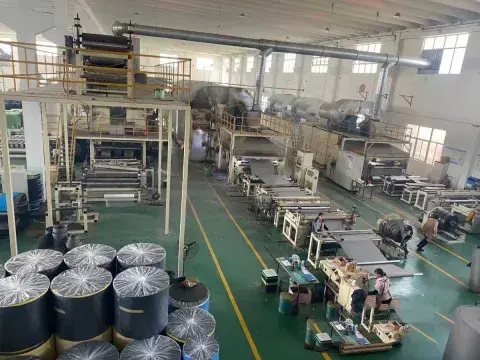
Five production lines run a combined 5,000 tonnes a year out of a 10,000 m² facility. That scale is what lets us hold a specification across repeat orders — the same density, the same cell structure and the same colour, whether you order one pallet or a full container.
Inside the Plant
Extrusion, cross-linking, lamination and conversion all happen under one roof, which is unusual at this size and is why a custom construction can be quoted without farming it out to a second factory. There is no mystery to the offer: five lines, a 10,000 m² plant, and the ability to hold a specification from the first sample to the thousandth order.
What We Make
XPE foam — chemically cross-linked polyethylene, our core product. Closed-cell, water-resistant, buoyant and chemically inert, with expansion ratios from 3x to 40x and densities from 26.8 to 300 kg/m³. Supplied in rolls, sheets and die-cut parts.
IXPE foam — the irradiation cross-linked grade. A finer, more uniform cell gives a smoother surface and tighter thickness control at the thin end, from 0.1 mm in a single layer. Preferred wherever appearance and precise gauge matter.
IXPP foam — cross-linked polypropylene, for higher service temperatures, greater stiffness and better recovery after repeated compression than polyethylene can offer.
PE foam — non-cross-linked polyethylene for general cushioning and protection: a lower-cost option where cross-linking is not required.
Laminated and composite foam — XPE, IXPE and IXPP bonded to film, foil, fabric, non-woven, adhesive or a second foam, so the surface the customer sees or touches can be engineered separately from the core.
Silicone materials — for applications that need wider temperature tolerance and a softer, more compressible feel than polyolefin foam can give.
How We Work With You
A useful enquiry carries three things: the part or drawing, the job it has to do, and the environment it has to survive. Temperature range, contact with water, oil or chemicals, whether the part will be seen, and how it will be fixed in place — each of those narrows the choice of material and surface.
From there the usual route is a sample or a small trial run, so the material can be tested in your own process before anyone commits to tooling. We would rather prove a grade on a sample than ship a container that has to come back. If your requirement is unusual — a colour match, a laminated surface, a tolerance tighter than we would normally quote — say so at the start and we will tell you straight away whether it is something we can hold.
From Roll to Finished Part
Most customers do not buy foam by the roll; they buy a part. We convert in-house:
- Precision die-cutting and CNC routing of complex profiles
- Lamination to film, foil, fabric, non-woven and adhesive
- Adhesive coating and release-liner supply
- Slitting, sheeting and edge trimming
- Thermoformed trays and custom shapes
- Assembly of multi-layer and multi-material parts
Tooling and sampling sit in the same building as the extrusion lines, so a change to the foam and a change to the cut happen together rather than across two suppliers.
Rolls, Sheets and Cut Parts
Standard supply is roll or sheet in widths from 500 mm to 2,000 mm. XPE runs from 3 mm to 15 mm in thickness; IXPE goes down to 0.1 mm in a single layer and up to 15 mm. Density is quoted either as an expansion ratio, from 3x to 40x, or as weight per cubic metre, from 26.8 to 300 kg/m³ — the two describe the same range, and we will quote in whichever unit your drawing uses.
Beyond that, most orders leave the roll behind. Send a finished geometry and we will propose the least wasteful way to cut, laminate or form it — and tell you honestly if a different grade would do the job better.
Industries and Applications
Our foam ends up in a wide range of finished products:
- Packaging — protective liners, inserts and cases for electronics, glass, cosmetics and industrial components
- Construction — underlay, expansion joint filler and acoustic insulation
- Automotive and transport — interior trim, gaskets and thermal barriers
- Sports and leisure — mats, protective gear and marine floatation
- Air-conditioning and insulation — thermal break and duct panels
- Case and bag making — structural foam for luggage, tool boxes and footwear
Why Work Directly With the Manufacturer
Buying from the factory removes a layer of margin and a layer of guesswork. You talk to the people who set the line, not to a reseller passing messages along it, and a question about density, tolerance or a sample gets an answer grounded in how the material is actually made. We take both container-scale orders and the smaller, awkward jobs that make a supplier worth keeping.